
What to Know About Alligators Before Renting a Lagoon View or Pool Home on Hilton Head Island
Quick Answer: Alligators are a completely normal part of life on Hilton Head Island and the vast majority of guests never have a concerning encounter. The simple rule is this: give them space, keep pets and children away from lagoon edges, and never feed them. Follow that guidance and a lagoon view or pool home on Hilton Head is a wonderful place to stay.
There is a question that comes up in almost every conversation we have with first-time visitors renting a lagoon view home or a property backing up to one of the island’s many freshwater ponds. It usually sounds something like this: we are excited about the view, but should we be worried about alligators?
It is a fair question and it deserves a straightforward answer.
Hilton Head Island is home to a significant population of American alligators. They live in the lagoons, ponds, and freshwater waterways woven throughout the island’s residential communities, golf courses, and nature preserves. They have been here far longer than the island’s neighborhoods have, and they are as much a part of the Hilton Head landscape as the Spanish moss and the tidal marsh.
What they are not, in the overwhelming majority of circumstances, is a threat to guests who understand how to share the space with them. Serious incidents are very rare and almost always involve someone getting too close, surprising an animal, or making the serious mistake of feeding one. None of those things need to happen on your trip.
Here is what the Coastal Luxury team tells every guest staying in a lagoon view or waterfront property on the island.
Alligators Are Part of What Makes Hilton Head Special
It helps to understand what you are actually looking at when you see an alligator on Hilton Head.
Most sightings happen on lagoon banks and pond edges in the early morning or late afternoon, when alligators move into the sun to regulate their body temperature. On a spring or fall morning it is genuinely common to spot one lying completely still on the bank behind a property, unbothered by the humans nearby, doing exactly what alligators have done in this ecosystem for an extraordinarily long time.
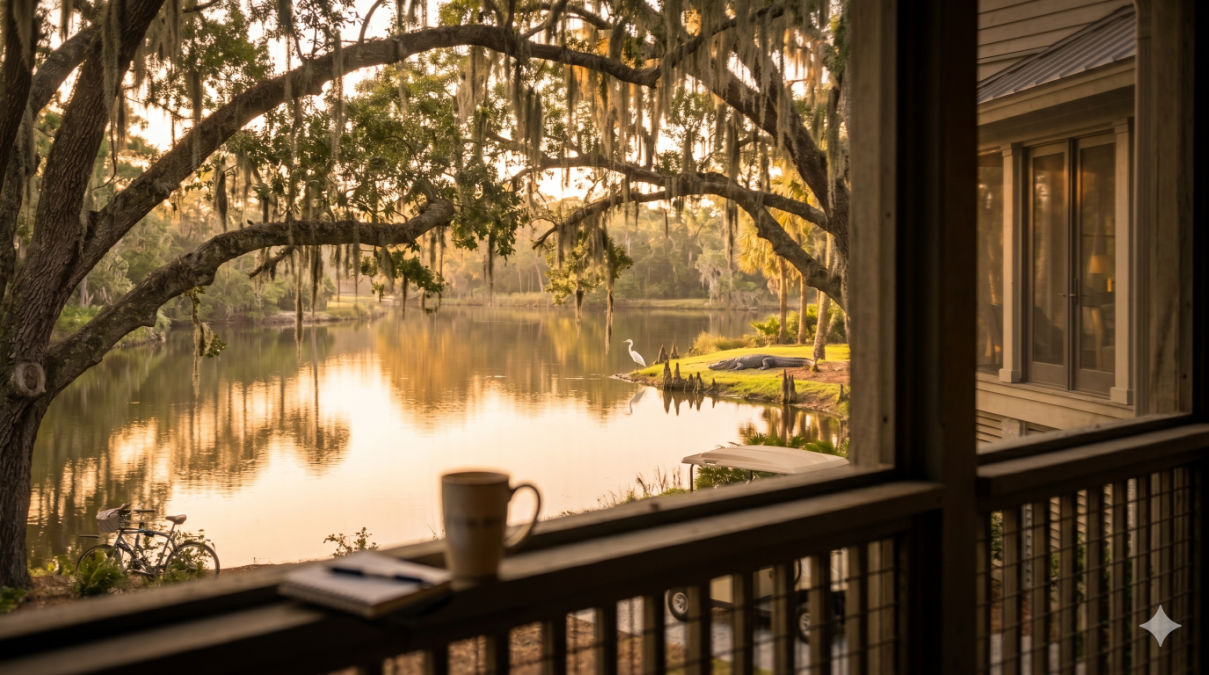
Many of our repeat guests specifically request lagoon view properties because of this. There is something genuinely remarkable about sitting on a screened porch with a coffee watching a five-foot alligator ease along the edge of the lagoon twenty yards away.
It is the kind of wildlife encounter that most people from outside the Southeast have never experienced, and it is part of what gives Hilton Head its particular sense of place.
The island’s master-planned communities were designed with this coexistence in mind. Sea Pines, Palmetto Dunes, Hilton Head Plantation, and the other established gated communities all have lagoon systems that are actively managed according to South Carolina Department of Natural Resources guidelines and local community protocols.
The alligators in these communities generally behave as wild animals should: they are wary of humans, they stay near the water, and they do not go looking for interaction.
Simple Rules That Keep Everyone Safe
Alligators on Hilton Head are not domesticated, and they should never be treated casually. The guidance below is not meant to alarm anyone. It is simply what responsible island living looks like, and it is the same information communicated by every community association and wildlife authority on the island.
Keep sixty feet of distance. Sixty feet is the standard recommended by South Carolina DNR and consistently enforced by Hilton Head’s community associations. That is roughly the length of four cars parked end to end. In practice it means not approaching for a closer look or a photograph, which is the most common way avoidable incidents happen.
Do not swim in freshwater lagoons or ponds. The beach and the ocean are where swimming happens on Hilton Head. The island’s freshwater lagoons are alligator habitat, and swimming in them is both prohibited and genuinely dangerous regardless of whether you can see an alligator at the time. A private pool at a rental property is completely separate from this and carries no alligator risk whatsoever.
Supervise children near lagoon edges. Young children playing near the water’s edge of a lagoon should always have adult supervision. The lagoon itself is not off-limits to look at or enjoy from a sensible distance. Walking right up to the bank, however, is not something children should do unsupervised.
Keep pets leashed near any water. Dogs are the most common source of avoidable encounters on the island because their movements and splashing near water can trigger a predatory response. Keep dogs on a leash near any lagoon or pond, do not let them wade at the water’s edge, and be especially attentive during dawn and dusk when alligators are most active.
Never feed an alligator under any circumstances. This point is worth being direct about because the consequences are serious. An alligator that has been fed by humans loses its natural wariness and begins approaching people rather than avoiding them. When that happens, wildlife management officials have no choice but to remove and euthanize the animal. Feeding a Hilton Head alligator is not just dangerous for the person doing it. It is a death sentence for the animal.
What About the Private Pool?
One of the most common follow-up questions we hear is whether alligators can end up in a private pool at a rental property.
The short answer is that it is extraordinarily unlikely. Alligators are freshwater animals and they are not drawn to chlorinated pools. They do not wander far from the lagoon systems they inhabit.
The rare cases of alligators appearing in unexpected places on the island typically involve large animals moving between water sources during mating season in spring, and even those situations are isolated and uncommon.
If your rental property has a pool, use it with complete confidence. If it backs up to a lagoon and you are curious about the wildlife living in it, enjoy observing from the porch or yard at a sensible distance. Those are two separate experiences and both are genuinely part of what makes a lagoon view home on Hilton Head worth choosing.
Why Lagoon View Homes Are Worth Choosing
Guests who stay in lagoon view properties on Hilton Head tend to be among the most enthusiastic about coming back, and it is not hard to understand why.
The view from a screened porch over a calm lagoon at sunrise, with egrets working the shallows and the occasional alligator moving slowly along the far bank, is one of the island’s genuinely distinctive pleasures. It is quieter than the beach corridor.
It is more private than properties in high-traffic areas. And the mature live oak canopy and maintained lagoon edges that define these settings give the Lowcountry landscape a beauty that is specific to this part of South Carolina and unlike anywhere else.
Families who love wildlife find that a lagoon view property makes the island feel like a nature experience as much as a beach vacation. Couples who want a peaceful, private retreat tend to gravitate toward these settings over the busier beachfront areas.
Multi-generational groups who want space, privacy, and the kind of porch that earns its keep morning and evening find lagoon view homes consistently deliver what they came for.
The tradeoff compared to a direct beachfront property is simply distance to the sand, which on Hilton Head is rarely more than a short bike ride. Most guests decide fairly quickly that the privacy, the quiet, and the wildlife access are worth that tradeoff.
Dawn, Dusk, and Knowing When to Watch
One detail that surprises guests is how much the alligator experience changes with the time of day and the season.
Alligators are cold-blooded, meaning they rely on their environment to regulate body temperature. In cooler months they move onto the lagoon banks to warm up in the sun, which is why spring and fall tend to offer the best sightings from a safe distance.
In peak summer heat they stay in the water to cool down, which means you may see very little of them during the hottest July afternoons.
Dawn and dusk are when alligators are most active and most likely to be moving around the lagoon edges. These are also the times when dogs on walks near water require the closest attention. A quiet sunrise walk along a lagoon path on Hilton Head is a beautiful experience. It is simply one where keeping the dog leashed and eyes forward is the right call.
The Honest Summary
Hilton Head’s alligators are not something to fear. They are something to respect, which is a different thing entirely.
Guests who approach them with the same calm awareness that full-time island residents carry, which is essentially a relaxed acknowledgment that they are there followed by a sensible amount of distance, have nothing to worry about.
The island has been welcoming families, couples, and multi-generational groups to homes along its lagoons for decades. The wildlife is part of the experience. So is the knowledge of how to enjoy it without incident.
Give them space. Keep pets close. Never feed them.
The rest is just watching the marsh do what it has always done, which on a quiet morning on Hilton Head Island is one of the better things going.
Coastal Luxury manages vacation rental properties across Hilton Head Island’s established communities, including lagoon view homes throughout Sea Pines, Palmetto Dunes, and beyond. If you have questions about a specific property or want honest guidance on which setting is right for your group, whether that is a private pool home, a lagoon view retreat, or something right on the beach, our team is happy to help. Browse available homes at coastalluxuryhhi.com or reach out directly.